
Written by our lead diver at Scuba Space, a PADI Master Scuba Diver and Law Enforcement Public Safety Diver with 12+ years of professional underwater operations experience.
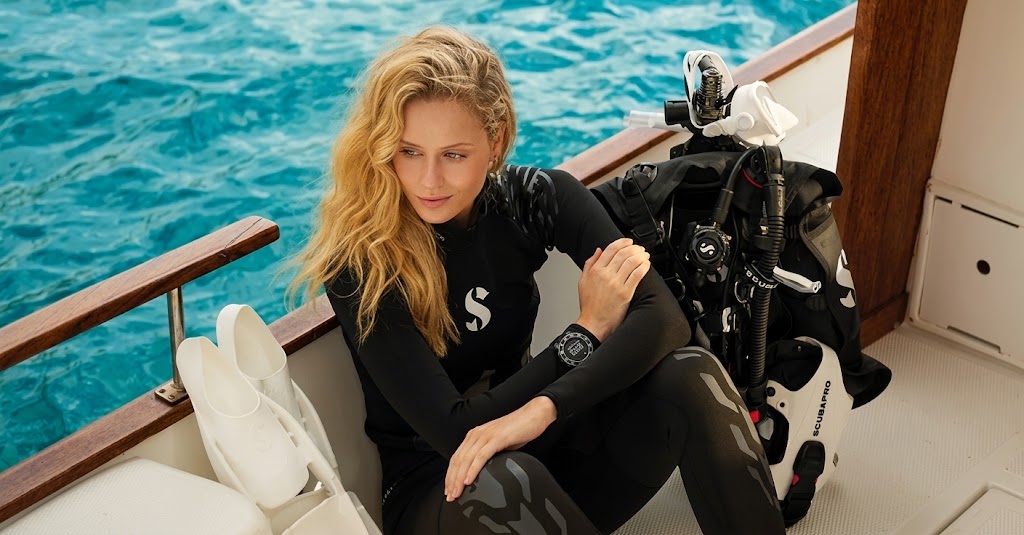
Your wetsuit is your protection against cold water, sunburn, scrapes, and jellyfish. It keeps you warm enough to enjoy longer, more comfortable dives instead of shivering and cutting the dive short.
Without the right wetsuit, cold water drains your body heat fast. You use more air. You lose focus. The right one lets you stay relaxed and dive longer.
This guide explains what is a scuba wetsuit and what beginners should look for.
Let’s get into it!
Interested in diving? Learn about the certifications here:
*Scuba Space is a participant of affiliate programs and earns from qualified purchases*
What is a Wetsuit?
A scuba wetsuit is a neoprene garment that traps a thin layer of water against your skin. Your body heat warms that water. The neoprene insulation slows heat loss. This keeps you warmer than swimming bare skin or in regular clothes.
Wetsuits come in different thicknesses measured in millimeters (mm). Thicker suits (5mm – 7mm) are for cold water. Thinner ones (1mm – 3mm) are for warm water.
Most beginners start with a 3mm or a 5mm wetsuit.
How Does a Wetsuit Work?
Neoprene is a synthetic rubber with tiny closed-cell air bubbles. These bubbles trap water and slow heat transfer. When you first get in the water, cold water enters through the neck, wrists, and ankles. Your body quickly warms the thin layer inside the suit. After a few minutes, you feel warm and stable.
The suit must fit snugly. Too loose and cold water flushes through constantly. Too tight and you restrict breathing and movement. Good suits have sealed seams (glued and blind-stitched or taped) to reduce flushing.
Scuba Wetsuit Terminology
Neoprene: The main material used in wetsuits. It’s a synthetic rubber foam with thousands of tiny closed air bubbles that trap body heat and slow down heat loss to the water.
Closed-cell foam: The structure inside neoprene. The air bubbles are sealed (closed), so they don’t fill with water. This is why wetsuits insulate even when wet.
Thickness: Measured in millimeters (mm). A 3/2mm suit means 3mm thick on the torso and 2mm on arms/legs. Thicker = warmer.
Nylon lining: The smooth fabric on the inside and/or outside of the suit. Makes it easier to put on, protects the neoprene, and adds durability.
Smoothskin: A slick, rubbery surface (no nylon) on parts of the suit (usually neck, wrists, ankles). Reduces water flow and improves warmth.
Glued and blind-stitched seams: (GBS) Common seam construction. Panels are glued together, then stitched from one side only so the needle does not go all the way through (less water leakage).
Taped seams: Extra tape applied inside over the seams for even less water entry. Found on higher-end or cold-water suits.
Water flush: When cold water constantly enters and exits the suit (usually from loose fit or poor seals). Causes rapid heat loss and discomfort.
Thermal insulation: The wetsuit’s main job. Slowing down the transfer of your body heat to the colder water around you.
Rash protection: Even thin suits or rash guards protect against sunburn, coral scrapes, and jellyfish stings.
Types of Scuba Wetsuits
Wetsuits come in different styles based on how much of your body they cover and the water temperature they’re made for. Here are the main types beginners should know:
Full Suit
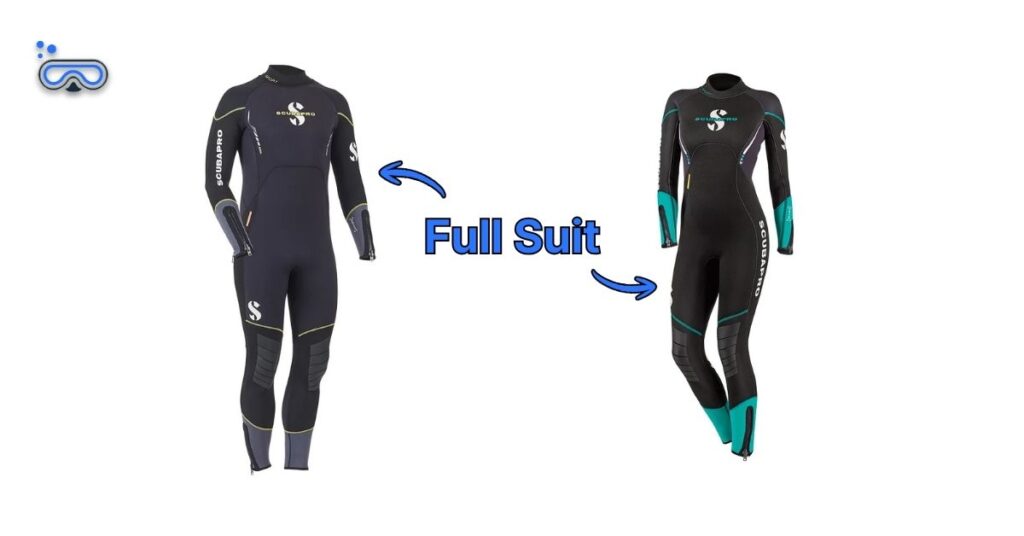
A full suit (also called a steamer) covers your entire body from neck to ankles, with long sleeves and long legs. It usually has a high collar to seal around the neck. Thickness ranges from 3mm to 7mm, with 3/2mm (3mm torso, 2mm arms/legs) and 5/4mm being the most common for beginners.
Full suits are the go-to choice for moderate to cold water (roughly 60 – 75°F or 15 – 24°C). They give you the best overall warmth and protection from sun, jellyfish, rocks, and minor scrapes. Most divers in temperate or seasonal climates start with a full suit.
They come with different entry styles (back zip, chest zip, no-zip) and seam types (glued & blind-stitched or taped), but the defining feature is full coverage from head to toe.
Pros
- Maximum warmth
- Full-body protection
- Versatile for variable conditions
- Most common type
Cons
- Harder to put on and take off
- Can feel restrictive if the fit is too tight
- Heavier and bulkier than shorties or rash guards when packing for travel
- More expensive than shorties or rash guards
I started with a 3mm when I began my Open Water cert. From my experience diving with it, I always felt it didn’t give me enough warmth, and this was diving with it in tropical places like Thailand, Cozumel, Fiji, etc. I’m particularly sensitive to cold. If you’re like me, I’d say to start with a 5mm.
Editor’s Note
Check out these links for some options:
Two-Piece
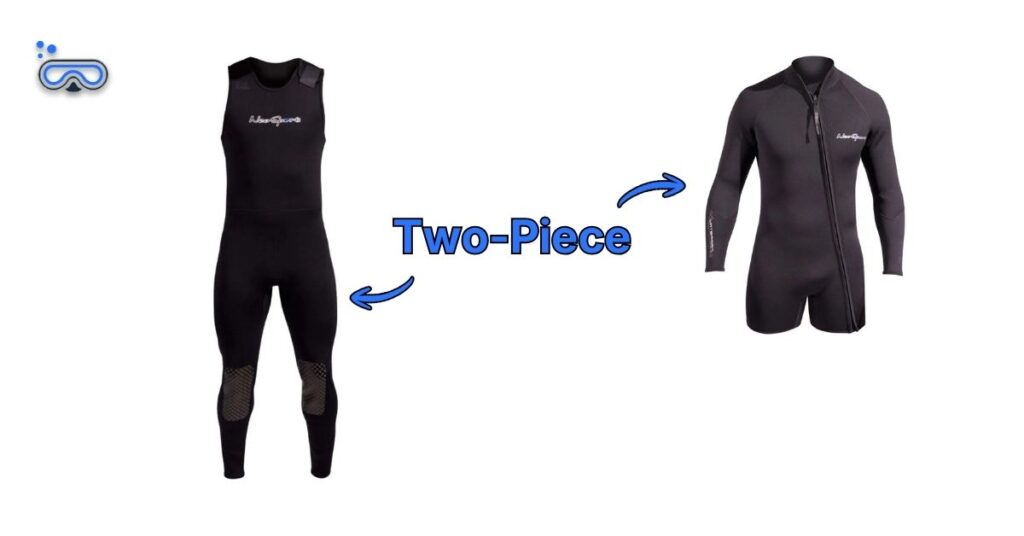
A two-piece wetsuit (also called Farmer John, Farmer Jane for women) is made up of two separate pieces: long john bottoms that cover the legs and torso like overalls, plus a separate jacket or top with sleeves. The jacket usually overlaps the bottoms at the waist for extra insulation around the core. Thickness is usually 5mm to 7mm, often with 7mm or 10mm equivalent in the torso when layered.
Two-piece suits are designed for cold water (below 65°F / 18°C) or variable conditions. The layered torso gives you maximum core warmth while the separate pieces make it easier to put on and adjust for temperature changes. They’re popular with technical divers, cold-water enthusiasts, and people who want flexibility.
Pros
- Excellent core warmth
- Easier entry
- Layering flexibility
- Less water flush at the waist
Cons
- More pieces to manage
- Heavier and bulkier than a full suit when fully layered
- Harder to find in rental shops
- Usually more expensive than basic full suits
Spring Suit
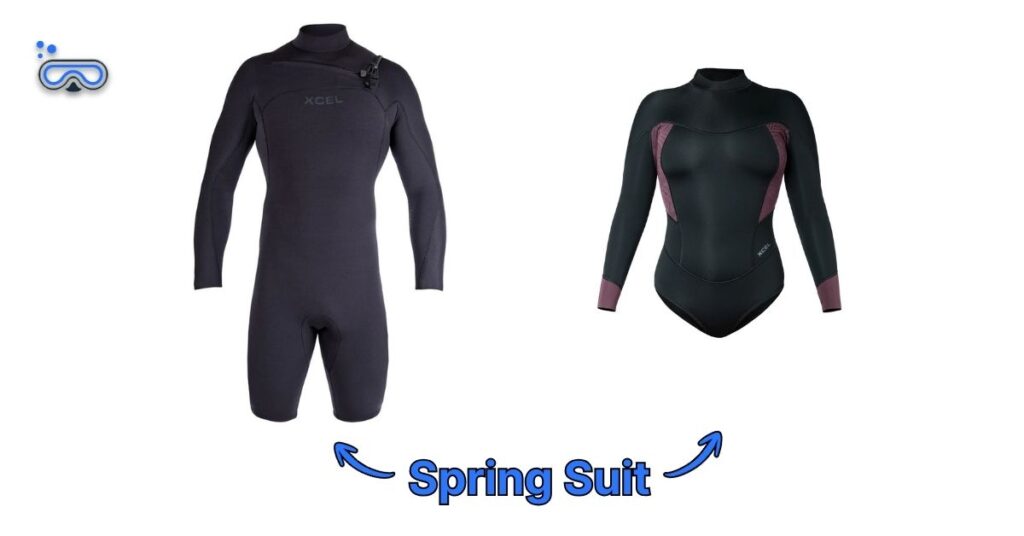
A spring suit is a wetsuit that doesn’t provide full coverage. We’ll be specifically referring to a long-sleeve, short-leg wetsuit as a spring suit here. Thickness is typically 2mm to 3mm, sometimes 3/2mm with slightly thicker torso panels.
Spring suits are designed for mild or transitional water temperatures (roughly 68 – 78°F / 20 – 26°C). They offer more upper body protection than a classic shorty. They’re popular in spring and fall seasons, or in areas where water temps vary between warm surface and cooler depths.
Pros
- Good balance of warmth and mobility
- Less restrictive than a fullsuit
- Lightweight and packable
- More coverage than a shorty
Cons
- Legs can get cold in cooler conditions
- Less common in rentals
- Mid-range price. More expensive than a shorty
Shorty
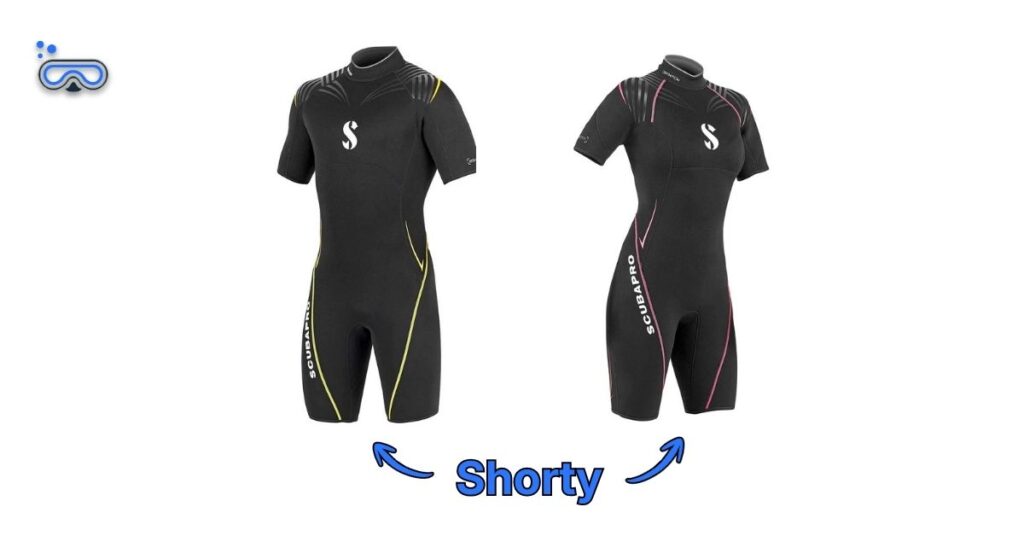
A shorty has short sleeves (to the elbow or upper arm) and short legs (to mid-thigh or knee). Thickness is typically 1mm to 3mm, with 2mm or 3mm being the most common.
Shorties are designed for warm water (roughly 75 – 85°F / 24 – 29°C) or tropical diving. They give you minimal thermal insulation but excellent protection from sunburn, jellyfish stings, coral scrapes, and minor abrasions. They’re popular for shallow reef dives, snorkeling, or summer conditions where full coverage would cause overheating.
Pros
- Very easy to put on and take off
- Excellent mobility
- Lightweight and compact
- Great sun and rash protection
- Affordable and widely available
Cons
- Limited warmth
- Less protection on arms and legs
- Can feel too minimal in cooler morning/evening dives.
- Shorter legs may ride up during movement or fin kicks.
- Not ideal for longer or deeper dives
We’ve put together a list of or recommended shorties here:
Rash Guard
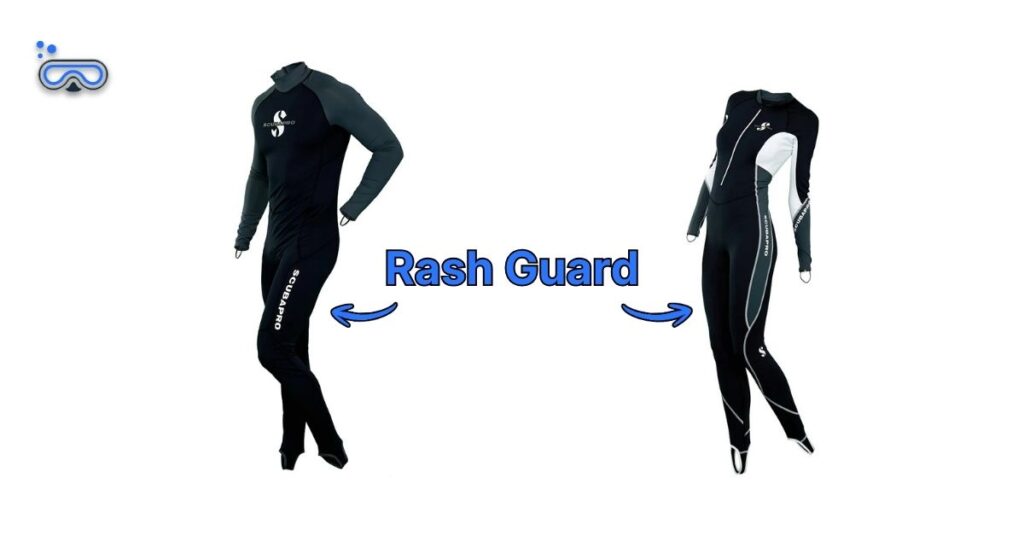
A rash guard (also called skin suit, dive skin, or lycra suit) is a thin, stretchy garment made from lycra, spandex, or very thin neoprene (0.5mm to 2mm). It can be a top-only piece (like a shirt) or a full-body suit covering from neck to ankles. It has no significant insulation but provides light protection.
Rash guards are designed for very warm water (above 80°F / 27°C) or tropical diving. They give you excellent sun protection, prevent jellyfish stings, and shield against minor coral scrapes and abrasions. They’re popular for snorkeling, shallow reef dives, or as an underlayer in warmer conditions.
Pros
- Excellent sun protection
- Great rash and sting protection
- Ultra-lightweight and packable
- Highly breathable and quick-drying
- Affordable and easy to find
- Can be worn alone or layered under other suits for extra protection
Cons
- No real thermal insulation
- Less durable than thicker neoprene
- Not a true wetsuit
Semi-Dry Suit
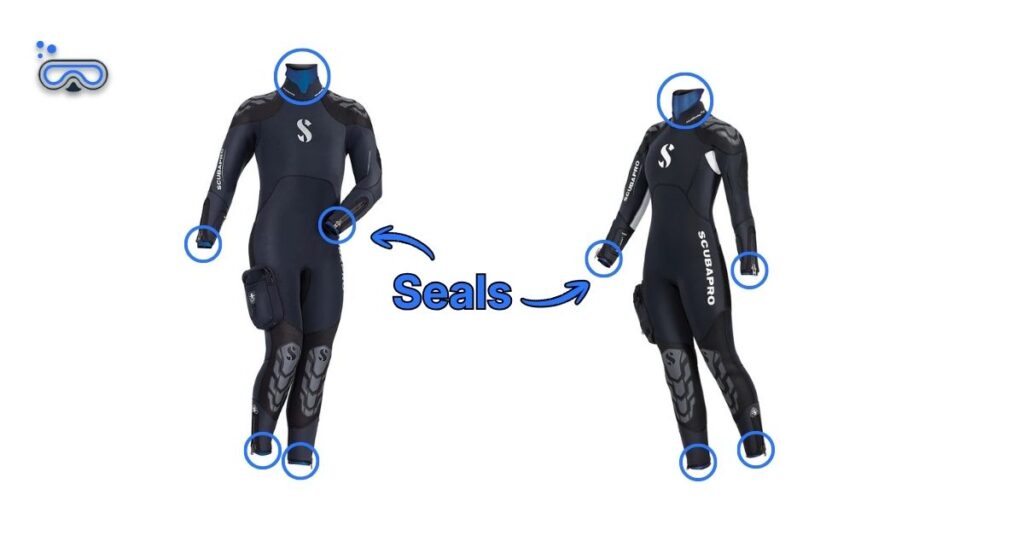
A semi-dry wetsuit is a full-body suit with enhanced seals and gaskets at the neck, wrists, and ankles to drastically reduce water flushing. Thickness is usually 5mm to 8mm, often with 6/5mm or 7/5mm construction and extra insulation in the torso.
Semi-dry suits are designed for cold water (below 65°F / 18°C) where a standard full suit isn’t warm enough. They bridge the gap between traditional wetsuits and true drysuits. They still let a small amount of water in, but far less than a regular wetsuit, so your body heat warms that water quickly and keeps you comfortable longer.
Pros
- Much warmer than standard wetsuits
- No need heavy undergarments or complex seals
- No need for drysuit certification or extra training
- Simpler and cheaper than drysuits.
Cons
- Still lets some water in
- Heavier and bulkier than standard wetsuits
- Can feel restrictive if the fit is too tight or seals are overly snug
I went to a Aqualung SolaFX soon after I completed my Open Water cert. It’s discontinued now, but looks very much like its successor. I had to suffer through poorly fitted rentals during the cert ’cause my 3mm wasn’t gonna cut it in 50° F water. The semi-dry suit worked very well but was a pain to put on. It annoyed me so much that I ended up getting custom wrist and ankle zippers put in, which basically turned it into a regular wetsuit.
Editor’s Note
Wetsuit Entry Styles
How a wetsuit opens and closes is called the entry style. It affects how easy it is to put on, how much water gets inside, and how warm the suit stays. Here are the main types beginners should know:
Back Zip
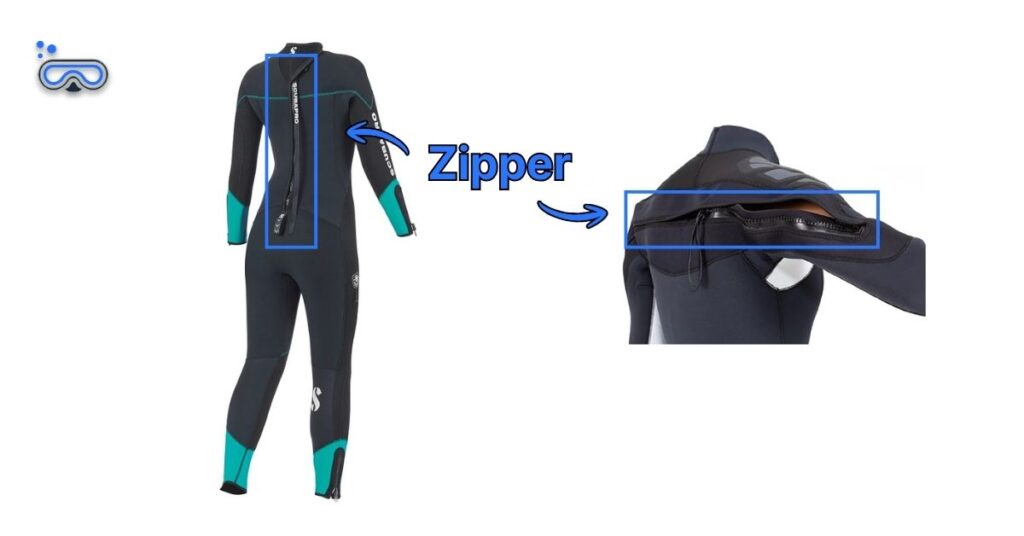
The back zip (or rear-entry zipper) usually runs straight down the back from the neck to the lower back or waist. There are also back zips that run horizontally along the upper back. For both styles, you unzip it fully to open the suit, step in feet-first, pull the suit up over your body, then zip it closed. Most suits include a long pull cord or loop so you can reach the zipper yourself, but many people still need a buddy to zip it all the way up.
Back zips are the most common entry style on beginner and mid-range wetsuits. They’re simple, reliable, and easy to use once you get the hang of the pull cord. They work well with most thicknesses and are the default on many rental suits.
Pros
- Easiest entry for most beginners
- Quick to get in and out with practice or help
- Works well even with cold hands or gloves
- Easy to find in shops, rentals, and online.
Cons
- Needs a buddy or long pull cord to zip up fully
- Water can flush in through the zipper teeth
- Zipper can jam or wear out over time if not rinsed and lubricated properly
- Less warm than chest zip or no-zip designs
When I mention that rear-entry is “easiest” for beginners, I’m specifically talking about the vertical back zip with the long cord. The horizontal zip requires a second person to help you suit up. I have years worth of memories walking in front of people with my Everdry 4 trying to get their attention to unzip me.
Editor’s Note
Front Zip
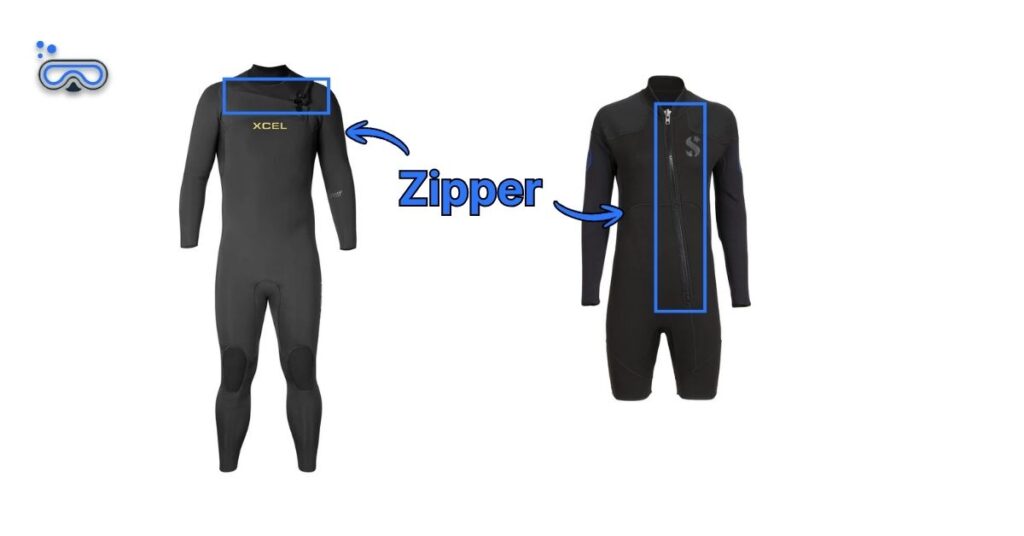
The front zip (also called chest zip) can run diagonally across the front or down one side of the torso, horizontally across the collarbone, or vertically down the center of the chest. You unzip it to open the suit, step in feet-first, pull the suit up, then zip it back up yourself. The zipper is usually shorter than a back zip and often has a waterproof flap or gasket.
Front zips are popular on modern, higher-end wetsuits because they seal better and are easier to use alone. They’re common on full suits and semi-dry suits designed for colder water or divers who want less flushing.
Pros
- Easy to zip up yourself
- Better warmth
- Less flushing
- Popular on premium suits
Cons
- Harder to get into at first
- Usually more expensive
- Zipper alignment can be tricky
Zipperless
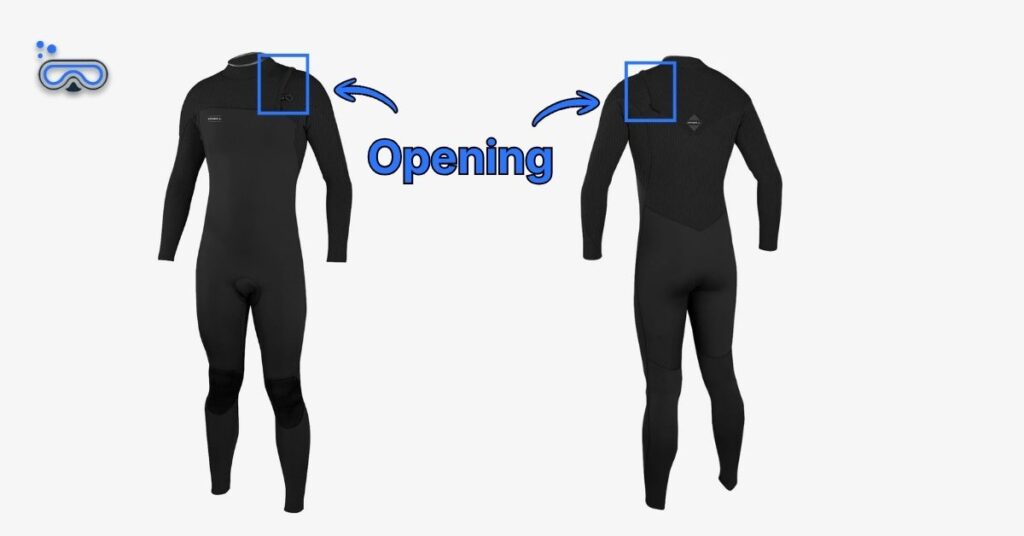
Zipperless wetsuits (or zipless) have no zipper at all. You stretch the opening wide to put it on like a very tight shirt or bodysuit. The opening is made from extra-stretchy neoprene or smoothskin material to make entry possible. Zipless suits are designed for maximum warmth. Without a zipper, there are no leak points, so very little water flushes in.
As you shop around, you’ll find two-piece zipperless wetsuits that are commonly marketed for freediving. These suits are thinner than normal scuba wetsuits and will damage much easier. You can go for them if you’re confident in your diving abilities.
Pros
- Warmest entry style
- Most streamlined fit
- No zipper to break, jam, or maintain
- Better for cold water
Cons
- Very difficult to put on
- Opening can feel tight or restrictive at first
- Not beginner-friendly
- Can wear out the opening area faster from constant stretching and pulling
Common Questions About Scuba Wetsuits for Beginners
Do I need a wetsuit in warm water?
Not always for warmth, but yes for sun protection and minor scrapes. A 1–2mm shorty or rash guard is enough in 80°F+ water. It prevents sunburn and jellyfish stings.
How thick should my first wetsuit be?
Start with 3/2mm or 5mm fullsuit if you dive in water below 75°F. If you only dive in tropical spots, a 3mm shorty is plenty. Check average water temps at your dive sites.
Back zip, chest zip, or no zip?
Back zip is easiest for beginners. You can get in and out quickly. Chest zip and no-zip are warmer (less flushing) but harder to put on alone. Start with back zip.
How long does a wetsuit last?
With proper care (rinse after every dive, hang dry out of sun, avoid sharp objects), 3 – 5 years or 100 – 200 dives. Neoprene breaks down from UV, salt, and stretching. Store it flat or on a thick hanger like the XS Scuba Travel Wetsuit Hanger.
Can I layer wetsuits?
Yes. Many divers wear a 3mm shorty under a 5mm fullsuit for extra warmth in marginal conditions. Just make sure both fit well so water does not flush between layers.
Wrapping Up
The best wetsuit for you isn’t always the most expensive one with the most features. It’s the one that you feel most comfortable using and keeps you warm.
The best way to know for sure is to try them. See if your local dive shop can help you find a wetsuit matches your diving needs.
You can also check online at shops with great return policies and fit guarantees. This is a super convenient way to do it if you don’t have any local shops in the area.
Don’t be intimidated by all the options out there. You’ll know when you’ve found the right one!
A wetsuit is just the start of your kit. To learn what else you need, check out our guide here:
Or if you’re ready to pick up your first, we’ve put together a list of our favorites:
You’ll also want to grab some of these items: