
What Is a Scuba Regulator? | 2026 Ultimate Guide | Scuba Space

Written by our lead diver at Scuba Space, a PADI Master Scuba Diver and Law Enforcement Public Safety Diver with 12+ years of professional underwater operations experience.
Your regulator is your lifeline underwater. It takes high-pressure air from your tank and delivers it to you at a breathable pressure, no matter how deep you go.
Without a good one, every inhale feels like work. You tire faster, use more air, and stress out. The right regulator makes breathing effortless, like you’re simply breathing air on land.
This guide breaks down what is a scuba regulator, how it works, the key terminology, the main types, and exactly what beginners should look for.
Let’s get into it!
*Scuba Space is a participant of affiliate programs and earns from qualified purchases*
What is a Scuba Regulator?
A scuba regulator is the device that safely supplies air from your tank on demand. You inhale, the regulator senses the drop in pressure and opens a valve to let air flow. You exhale, the valve closes, and bubbles escape through a one-way exhaust.
The regulator’s job is to reduce the tank’s high pressure (usually 3,000 psi when full) to ambient pressure at your depth. It does this automatically as you descend, so breathing stays consistent.
Modern regulators use a single hose design. The older double-hose style (with two hoses looping over the shoulders) is mostly vintage now. Single-hose regulators are lighter, simpler, and far more common for beginners.
How Does a Scuba Regulator Work?
The regulator has two main stages.
First stage: Attaches directly to the tank valve. It takes the high tank pressure and reduces it to an intermediate level (around 140 psi). This stage is sealed and durable. It has several low-pressure ports for the second stage, octopus, and inflator hose, plus high-pressure ports for the submersible pressure gauge (SPG).
Second stage: The mouthpiece you hold in your mouth. When you inhale, a flexible diaphragm moves inward. This triggers the demand valve to open, releasing air. When you exhale, the diaphragm pushes back, the valve closes, and exhaled air vents out through one-way exhaust ports.
The entire system is “demand-based.” Air only flows when you pull it in. This conserves gas and prevents free-flow. Some second stages use the Venturi effect to make airflow smoother (air rushing past creates low pressure that helps the valve stay open). Others have a Venturi switch to prevent free-flow at the surface.
Scuba Regulator Terminology
Let’s get into the details of some key parts and functions.
First stage: The part that screws onto the tank. Reduces main pressure.
Second stage: The part you put in your mouth that delivers air.
Octopus (or alternate air source): Backup second stage for emergencies or buddy breathing.
Yoke: Clamp-style tank connection. Common in warm water.
DIN: Screw-in connection. Safer and more secure in cold or rough conditions.
Balanced: Breathing effort stays even regardless of depth or tank pressure.
Unbalanced: Breathing effort increases as tank pressure drops.
Venturi switch: Controls airflow direction to reduce free-flow.
Cracking effort: The effort needed to start airflow (lower is easier).
Intermediate pressure: The pressure between first and second stage (usually 140 psi).
Types of Scuba Regulators
Time for the fun part. We’re going into the different styles of diving regulators out there.
DIN vs INT (Yoke)
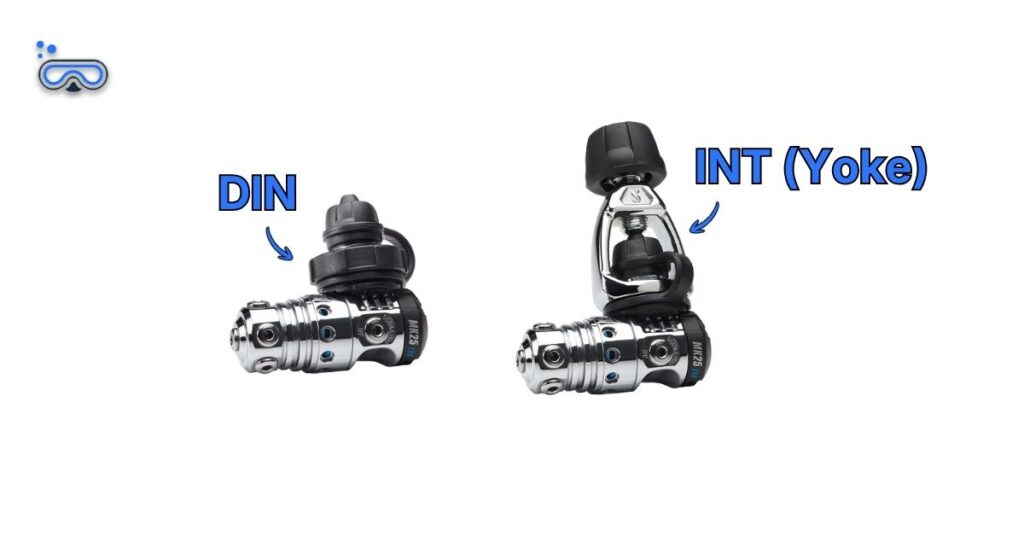
INT (Yoke): Uses a clamp that fits over the tank valve. You tighten a handwheel at the back to secure it. The O-ring sits on the tank valve itself (exposed until pressurized).
INT is the older, more common standard in warm-water and recreational diving (especially in the US, Caribbean, and many rental shops).
Pros
- Easier and faster to attach
- Widely compatible
- Lower cost
- Simple handwheel
Cons
- Exposed O-ring on the tank
- Less secure under high pressure or impact
- Limited to ~3,300 psi (232 bar) max
- Bulkier profile
DIN: Deutsche Industrie Norm, the German standard. Uses a threaded connection. The first stage screws directly into the tank valve. The O-ring is inside the regulator (protected).
DIN became popular for technical diving, cold water, and high-pressure tanks because it handles more stress and reduces failure risk.
Pros
- More secure connection
- Protected O-ring
- Handles higher pressures (up to 4,350 psi / 300 bar)
- Lower profile
Cons
- Slightly harder to attach
- Less common in rentals
- Higher cost
- Adapter needed for Yoke tanks
For maximum compatibility, get a DIN reg with an INT (Yoke) adapter. This way, you’ll be able to use your reg set in any part of the world.
Editor’s Note
Piston vs Diaphragm Regulator
Piston 1st Stage: Use a moving piston to regulate pressure. They respond quickly to your breathing. Air delivery feels crisp and immediate. They perform well in cold water because the piston design handles temperature changes effectively. However, they have more moving parts exposed to water, so they can be more prone to freezing in extreme cold or dirt in silty conditions.
Pros
- Fast response and crisp feel.
- Excellent cold-water performance.
- Often lighter.
Cons
- More moving parts to wear.
- Can freeze in extreme cold.
- Needs more frequent cleaning.
Diaphragm 1st Stage: Uses a sealed rubber membrane instead of a piston. The membrane flexes to control pressure without direct water contact. This makes them more resistant to dirt, silt, and freezing. They are the go-to choice for cold-water or dirty environments. The trade-off is slightly higher breathing effort compared to pistons.
Pros
- Sealed design resists dirt and silt.
- Better freezing resistance.
- More reliable in harsh conditions.
Cons
- Slightly higher breathing effort.
- Can feel less “crisp”.
I started with a HOG D3 Zenith (diaphragm) and switched to an Atomic Aquatics B2 (piston) about halfway through my dive career. I really didn’t notice any difference when it came to maintenance/cleaning. Both worked great.
Editor’s Note
Balanced vs Unbalanced Regulator
Balanced Regulators: Maintain consistent breathing effort no matter the depth or remaining tank pressure. The first stage compensates for pressure changes, so every breath feels the same. This is a game-changer at low tank levels or deep dives. Most modern regulators are balanced.
Pros
- Consistent effort at any depth.
- Easier breathing at low air.
- Less fatigue over long dives.
Cons
- Higher cost.
- Slightly heavier.
Unbalanced Regulators: Simpler and cheaper. Breathing effort increases as tank pressure drops. They work fine for shallow recreational dives, but they can become noticeably harder toward the end of a dive.
Pros
- Lower price point.
- Simple design.
Cons
- Harder breathing as tank empties.
- More tiring for beginners.
The only time I’ve used unbalanced regs were with rentals. I definitely prefer balanced. If it’s within your budget, without question, go for the balanced reg.
Editor’s Note
2nd Stage Regulator
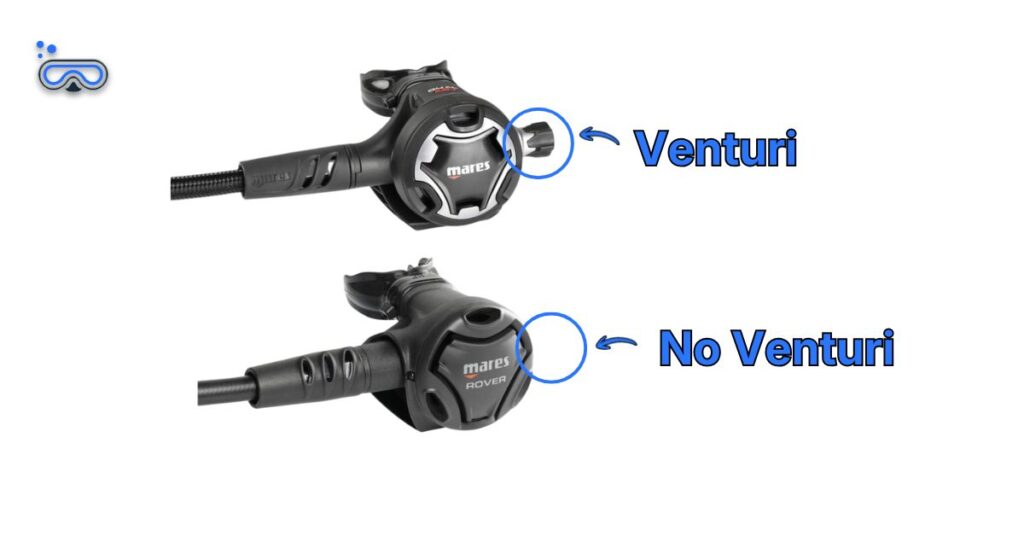
Downstream 2nd Stage: The most common. Air flows in a single direction through the valve. They are reliable and straightforward. They tend to free-flow more easily at the surface, but modern designs minimize this.
Pros
- Reliable and simple.
- Low cost.
- Easy to maintain.
Cons
- Higher free-flow risk without switch.
Upstream 2nd Stage: Less common. The valve design reduces free-flow risk.
Adjustable Venturi 2nd Stage: Adds a switch. It controls airflow direction and prevents unwanted free-flow.
Pros
- Controls free-flow effectively.
- Saves air.
Cons
- Switch can be confusing at first
My personal regs all have Venturi knobs. I like being able to customize the air delivery. I’ve also used my fair share of downstream rentals and they’ve all worked just fine if you can get past the occasional free flow at the surface.
Editor’s Note
Octopus Backup
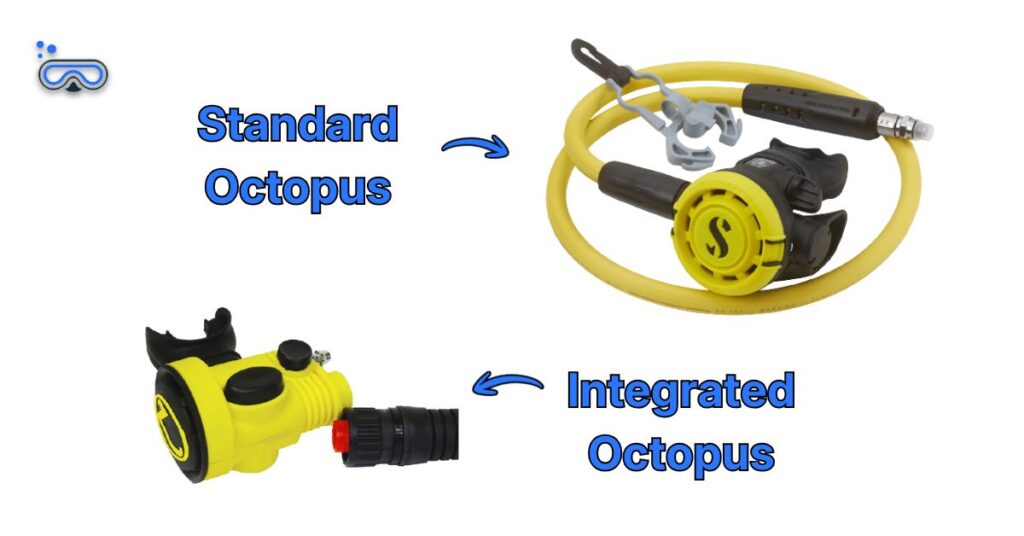
Octopus: Your emergency air source. It shares air with a buddy in an out-of-air situation. High-performance octopuses have larger diaphragms and easier breathing. Standard ones are sufficient for most recreational use.
Pros
- Dedicated emergency breathing.
- Longer hose (typically 40 inches).
- Simple to service and inspect.
- Widely available and familiar.
Cons
- Extra hose to manage.
Integrated Octopus: Emergency air source that’s integrated into the BCD inflator. In an out-of-air situation, you would give your buddy your normal regulator and transition to using the integrated octopus yourself.
Pros
- Fewer hoses.
- Built-in inflation.
- Streamlined for travel.
Cons
- Head angle awkward during use.
- Cracking effort is higher than a dedicated second stage.
- If the inflator fails, you lose both inflation and backup air.
As a public safety diver, I like to keep my hoses to a minimum. That said, I don’t use a standard octopus. I use an Octo Z or Air 2 instead (depending on the BCD). These things are convenient but are definitely not the most comfortable. They always turn my head at awkward angles when practicing buddy breathing.
Editor’s Note
Things to Look For
Here are some things you’ll want to keep in mind:
Balanced vs Unbalanced: Choose a balanced regulator if it’s in your budget. It feels easier to breathe at any depth.
Cold Water Rating: Check for cold-water rating if you dive in cooler spots.
Ports: Look for good port options. More ports mean flexibility.
Mouthpiece: Choose a comfortable mouthpiece. Many brands offer different sizes. Try before you buy or swap out to one you like.
Service: Service it yearly. A good warranty gives peace of mind.
Start simple and upgrade later if needed. Try before you buy or just go on a few trips and rent some first. You’ll figure out what you like best.
Common Questions About Scuba Regulators for Beginners
Do I need a high-performance regulator as a beginner?
No, you don’t. A solid balanced regulator will deliver smooth, effortless breathing without the extra cost or complexity of high-performance models. High-performance regulators shine in extreme conditions (deep dives, cold water, technical work) where every ounce of efficiency counts, but for recreational diving, the difference is minimal. Focus on comfort, fit, and reliability instead.
Yoke or DIN?
Go with DIN if possible. It’s more secure because it screws directly into the tank valve, reducing the risk of accidental disconnection under pressure or impact. Yoke (the clamp-style) is easier to attach quickly and is still the most common in warm-water rentals worldwide, so it works fine for beginners. The real key is flexibility: many modern DIN regulators include a removable yoke adapter (a simple doughnut insert) so you can switch between tank types easily. This makes DIN the most future-proof choice.
How often should I service it?
Service your regulator at least once a year or after every 100 dives, whichever comes first. This includes a full disassembly, cleaning, inspection of O-rings/seals, and testing of breathing performance. Skipping service is risky. Small wear or salt buildup can cause free-flow, harder breathing, or failure. Even if it “feels fine,” internal parts degrade over time.
Can I use a rental regulator forever?
Yes, you can. Rental regulators are professionally maintained, inspected regularly, and perfectly safe for recreational use. Many divers rent for years without issue. That said, owning your own gives you peace of mind: you know the exact service history, you can choose a mouthpiece that fits your mouth perfectly, and it feels more “yours.” Rentals are great for testing different brands or while traveling. Once you find a model you love, buying is usually worth it.
Wrapping Up
The best diving regulator for you isn’t always the most expensive one with the most features. It’s the one that you feel most comfortable using and keeps you safe.
The best way to know for sure is to try them. See if your local dive shop can help you find a computer matches your diving needs.
You can also check online at shops with great return policies and fit guarantees. This is a super convenient way to do it if you don’t have any local shops in the area.
Don’t be intimidated by all the options out there. You’ll know when you’ve found the right one!
A scuba regulator is just one part of the puzzle. To learn what else you need in your kit, check out our guide here:
Or if you’re ready to pick up your first, we’ve put together a list of our favorites:
Enjoyed the article? Share it with your fellow divers!