
Written by our lead diver at Scuba Space, a PADI Master Scuba Diver and Law Enforcement Public Safety Diver with 12+ years of professional underwater operations experience.
Choosing your first scuba certification can feel like a daunting task. Each agency promises to keep you safe and get you underwater, yet they all have distinct personalities.
Because every major agency follows the global standards set by the International Organization for Standardization (ISO) and World Recreational Scuba Training Council (WRSTC), a beginner certification from one is legally and technically equivalent to the others.
However, the experience of getting that C-Card varies based on how the material is taught, how the digital tools work, and how much freedom the instructor has to tailor the class to your needs.
This guide will break down the types of scuba certification available for beginners.
So, let’s not waste any more time and get into it!
*Scuba Space is a participant of affiliate programs and earns from qualified purchases*
PADI vs SSI vs NAUI Chart
To help you navigate the alphabet soup of scuba agencies, it’s important to show that while the names change, the skills remain largely the same. Below is an equivalency chart:
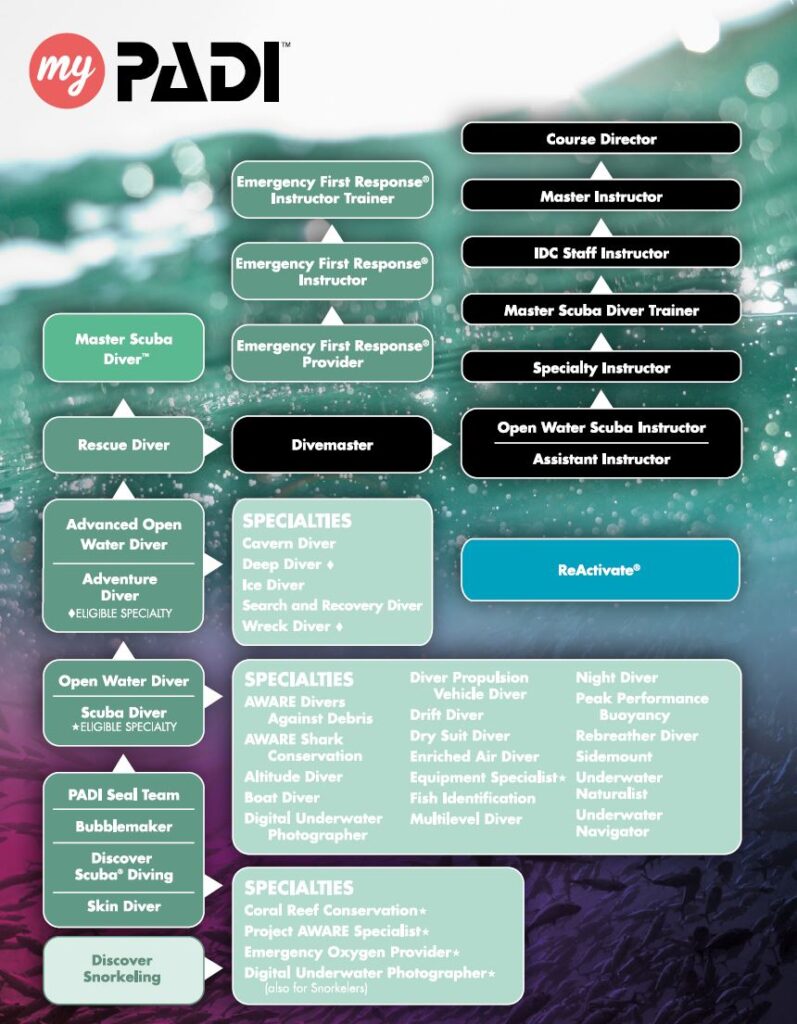
Here’s a nice flowchart of PADI courses to give you an idea of the general education path:
The Types of Scuba Certifications
When you begin researching scuba certifications, you’ll quickly realize that while there are dozens of training organizations, three names dominate the conversation: PADI, SSI, and NAUI. Collectively, these Big Three account for the vast majority of divers worldwide.
It’s important to understand that no matter which logo is on your certification card, you are receiving a high-quality education. All three agencies adhere to the strict international standards. This means that a mask clear or an emergency ascent skill is taught with the same safety protocols regardless of the agency.
The real difference between them isn’t what you learn, but how the material is delivered and managed. Each agency has carved out a unique niche in the market: one focuses on global convenience and branding, another on digital integration and shop-based communities, and the third on academic depth and instructor independence. Choosing the right one depends on your personal learning style.
Professional Association of Diving Instructors
PADI is the undisputed giant of the diving industry. It’s usually referred to as the “way the world learns to dive.” When you certify with PADI, you are entering a massive global network that prioritizes consistency and accessibility above all else. Their training materials are incredibly polished, offering a seamless eLearning experience that you can complete on your phone or laptop before you ever step foot in a dive shop. This standardized building-block approach makes sure that whether you’re in a quarry in Ohio or a reef in Fiji, the skills are taught in the exact same sequence.
The primary benefit of a PADI certification is its universal recognition. You will never find a dive center on Earth that doesn’t recognize a PADI card. However, this global reach comes with a higher price tag. PADI typically charges a premium for their learning materials and certification processing. For many, this is a fair trade for the convenience of having their records accessible at any resort worldwide. It’s the ideal choice for travelers who want a reliable, recognizable system and don’t mind paying a bit extra for the gold-standard brand name.
- Universal Recognition
- Educational Consistency
- Excellent Digital Materials
- Higher Cost
- Commercial Feel
I’m personally certified under PADI. This was largely due to the fact that the instructor on my dive team was a PADI instructor and I had no idea other certifications existed when I first started. I was able to complete all my certs all the way up to Master Scuba Diver through PADI.
Editor’s Note
Some other members of my dive team had some issues mixing certifications. They weren’t able to get the Master Scuba Diver certification because one of their certs (Dive Rescue 1) from another agency (Dive Rescue International) wasn’t recognized. Turns out DR1 is under a different standard than PADI/SSI/NAUI Rescue Diver.
Scuba Schools International
While PADI focuses on the individual instructor, SSI is built around the relationship between the diver and the local dive center. SSI has gained massive ground in recent years by being the most digital-forward agency. Their MySSI app is a central hub where your training materials, digital logbook, and certification cards all live for free. Unlike other agencies that might charge you for every digital update, SSI often gives you free access to basic course materials once you register with a shop. This makes it a very attractive option for budget-conscious beginners who want a modern experience.
One of the unique features of the SSI philosophy is the 80/20 rule of teaching. This lets instructors spend 80% of the time on the core curriculum while using the remaining 20% to customize the training to the specific environment or the student’s personal pace. If you are struggling with a specific skill, an SSI instructor has the flexibility to move on to something else and come back to the trouble spot once your confidence has grown. This student-centric approach makes SSI a favorite for those who find the idea of a rigid classroom setting a bit intimidating.
- Digital-First Convenience
- Teaching Flexibility
- Cost-Effective
- Smaller Global Presence
- Store-Dependent Administration
National Association of Underwater Instructors
NAUI is the academic and non-profit choice of the diving world, carrying the motto “Safety Through Education.” If you want a dive deep into the “why” behind the physics and physiology of diving, NAUI is likely your best fit. Because it’s a non-profit association, NAUI places a heavy emphasis on instructor freedom. Rather than following a strictly commercial cookie-cutter script, NAUI instructors are encouraged to teach to the point of mastery. This is why you’ll usually find NAUI used by university programs, scientific diving teams, and even NASA’s Neutral Buoyancy Laboratory.
A NAUI course might feel more like a college-level science class than a quick vacation certification. You may spend more time in the pool practicing rescue skills or learning the intricacies of dive tables, even in an age where most people rely on computers. While NAUI has a smaller global footprint than PADI, their reputation for producing highly skilled, self-reliant divers is unmatched. It’s the perfect agency for someone who isn’t just looking for a license to dive, but wants a foundational education in the science of scuba diving.
- Academic Rigor
- Instructor Autonomy
- Non-Profit Values
- Limited Global Reach
- Varying Experiences
Questions about Scuba Diving Certifications
Do scuba certifications expire?
No, your scuba certification is valid for life. Once you earn your C-Card from PADI, SSI, or NAUI, it never expires. However, if you have not been diving for six months or longer, most reputable dive shops will require you to complete a Refresher course. This is a short session in a pool with an instructor to ensure your safety skills, like mask clearing and out-of-air protocols, are still sharp before you head into open water.
Can I switch agencies after I start?
Absolutely. Because the major agencies follow universal ISO standards, they recognize each other’s foundational certifications. For example, if you earned your Open Water certification with PADI, you can move to a different shop and take your Advanced course with SSI or NAUI. You do not need to transfer or crossover your license. You simply show your existing card as proof that you’ve met the prerequisites for the next level.
How long does it take to get certified?
Most people can complete their Open Water certification in 3 to 4 days of in-person training. This usually includes one day of pool (confined water) work and two days of open water dives. This timeline assumes you have already completed your Knowledge Development or eLearning at home. If you prefer a slower pace, many local shops offer weekend schedules that spread the training over two or three weeks.
How deep can I dive once I’m certified?
An entry-level Open Water certification typically limits you to a maximum depth of 18 meters (60 feet). Once you complete an Advanced Open Water course, that limit increases to 30 meters (100 feet). While the absolute limit for recreational diving is 40 meters (130 feet), anything deeper than that is considered Technical Diving and requires specialized gear and training.
Do I need to be a great swimmer to dive?
You don’t need to be an Olympic athlete, but you do need to be comfortable in the water. Most agencies require a basic swim test before you can be certified, which typically involves swimming 200 meters (without a time limit) and treading water or floating for 10 minutes. If you can stay afloat and move yourself through the water comfortably, you have the physical skills needed to dive.
Which Scuba Certification is the Best?
In my opinion, there really isn’t a “best”. PADI definitely is the easiest one to find, though. If you walk into a random dive shop, chances are very high you’ll be certified through PADI.
Editor’s Note
Ultimately, you should choose the agency that’s supported by the dive shop where you feel most comfortable. Because the skills like clearing your mask, sharing air, and managing buoyancy are identical across all three.
The best certification is the one taught by an instructor who takes the time to make sure you’re truly confident. Visit your local shop, ask which agency they certify through, and if the training matches your goals, dive in.
If you’re a beginner looking to buy your first set of gear, check out these guides: